
momepy.Tessellation#
- class momepy.Tessellation(gdf, unique_id, limit=None, shrink=0.4, segment=0.5, verbose=True, enclosures=None, enclosure_id='eID', threshold=0.05, use_dask=True, n_chunks=None)[source]#
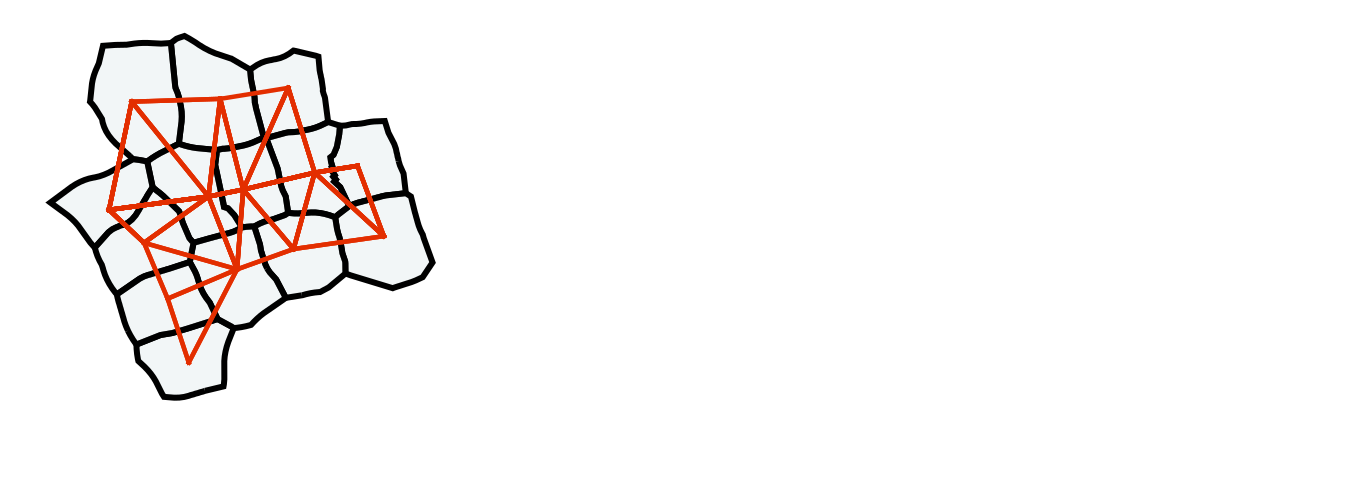
Generates tessellation. Three versions of tessellation can be created:
- Morphological tessellation around given buildings
gdfwithin setlimit.
- Proximity bands around given street network
gdf within set
limit.
- Proximity bands around given street network
- Enclosed tessellation based on given buildings
gdfwithinenclosures.
Pass either
limitto create morphological tessellation or proximity bands orenclosuresto create enclosed tessellation.See [Fleischmann et al., 2020] for details of implementation of morphological tessellation and [Araldi and Fusco, 2019] for proximity bands.
Tessellation requires data of relatively high level of precision and there are three particular patterns causing issues:
- Features will collapse into empty polygon - these
do not have tessellation cell in the end.
- Features will split into MultiPolygons - in some cases,
features with narrow links between parts split into two during ‘shrinking’. In most cases that is not an issue and the resulting tessellation is correct anyway, but sometimes this results in a cell being a MultiPolygon, which is not correct.
- Overlapping features - features which overlap even
after ‘shrinking’ cause invalid tessellation geometry.
All three types can be tested prior
momepy.Tessellationusingmomepy.CheckTessellationInput.- Parameters:
- gdfGeoDataFrame
A GeoDataFrame containing building footprints or street network.
- unique_idstr
The name of the column with the unique ID.
- limitMultiPolygon or Polygon (default None)
MultiPolygon or Polygon defining the study area limiting morphological tessellation or proximity bands (otherwise it could go to infinity).
- shrinkfloat (default 0.4)
The distance for negative buffer to generate space between adjacent polygons (if geometry type of gdf is (Multi)Polygon).
- segmentfloat (default 0.5)
The maximum distance between points after discretization.
- verbosebool (default True)
If
True, shows progress bars in loops and indication of steps.- enclosuresGeoDataFrame (default None)
The enclosures geometry, which can be generated using
momepy.enclosures().- enclosure_idstr (default ‘eID’)
The name of the
enclosure_idcontaining unique identifer for each row inenclosures. Applies only ifenclosuresare passed.- thresholdfloat (default 0.05)
The minimum threshold for a building to be considered within an enclosure. Threshold is a ratio of building area which needs to be within an enclosure to inlude it in the tessellation of that enclosure. Resolves sliver geometry issues. Applies only if
enclosuresare passed.- use_daskbool (default True)
Use parallelised algorithm based on
dask.dataframe. Requires dask. Applies only ifenclosuresare passed.- n_chunksNone
The number of chunks to be used in parallelization. Ideal is one chunk per thread. Applies only if
enclosuresare passed. Default automatically usesn == dask.system.cpu_count.
- Attributes:
- tessellationGeoDataFrame
A GeoDataFrame containing resulting tessellation. For enclosed tessellation, gdf contains three columns:
geometry,unique_idmatching with parental building,enclosure_idmatching with enclosure integer index
- gdfGeoDataFrame
The original GeoDataFrame.
- idSeries
A Series containing used unique ID.
- limitMultiPolygon or Polygon
MultiPolygon or Polygon defining the study area limiting morphological tessellation or proximity bands.
- shrinkfloat
The distance for negative buffer to generate space between adjacent polygons.
- segmentfloat
The maximum distance between points after discretization.
- collapsedlist
A list of
unique_id``s of collapsed features (if there are any).
Applies only if ``limit
is passed.- multipolygonslist
A list of
unique_id``s of features causing MultiPolygons (if there are any).
Applies only if ``limit
is passed.
Examples
>>> tess = mm.Tessellation(
... buildings_df, 'uID', limit=mm.buffered_limit(buildings_df)
... )
Inward offset...
Generating input point array...
Generating Voronoi diagram...
Generating GeoDataFrame...
Dissolving Voronoi polygons...
>>> tess.tessellation.head()
    uID     geometry
0   1       POLYGON ((1603586.677274485 6464344.667944215,...
1   2       POLYGON ((1603048.399497852 6464176.180701573,...
2   3       POLYGON ((1603071.342637536 6464158.863329805,...
3   4       POLYGON ((1603055.834005827 6464093.614718676,...
4   5       POLYGON ((1603106.417554705 6464130.215958447,...
>>> enclosures = mm.enclosures(streets, admin_boundary, [railway, rivers])
>>> encl_tess = mm.Tessellation(
... buildings_df, 'uID', enclosures=enclosures
... )
>>> encl_tess.tessellation.head()
     uID                                           geometry  eID
0  109.0  POLYGON ((1603369.789 6464340.661, 1603368.754...    0
1  110.0  POLYGON ((1603368.754 6464340.097, 1603369.789...    0
2  111.0  POLYGON ((1603458.666 6464332.614, 1603458.332...    0
3  112.0  POLYGON ((1603462.235 6464285.609, 1603454.795...    0
4  113.0  POLYGON ((1603524.561 6464388.609, 1603532.241...    0
- __init__(gdf, unique_id, limit=None, shrink=0.4, segment=0.5, verbose=True, enclosures=None, enclosure_id='eID', threshold=0.05, use_dask=True, n_chunks=None)[source]#
Methods
__init__(gdf, unique_id[, limit, shrink, ...])